
March 12, 2026
In this article, they considered modeling and statistical analysis of dependent competing risks time-to-event data in the presence of long-term survivors. They modeled the effect of the existence of long-term survivors in the population using a mixture cure rate models. Therefore, a finite mixture of Weibull models explains the uncertainty due to dependent competing failure modes in the susceptible part of the population.
As they have stated, one of the popular ways to model competing risks data is the latent failure times approach. The underlying time-to-event distribution may have a bimodal or multimodal density in the presence of multiple failure modes. The finite mixture distributions often become a very flexible family of distributions in this type of setup. The most popular approach to model data in the presence of cured subjects is the two-component mixture cure rate model. This model consists of a component representing the immune proportion, which is also known as incidence both the population and a distribution (also known as a latency distribution describing the time to the occurrence of the event of interest).For their likelihood function of the mixture of Weibull distributions, the EM algorithm can be used to obtain the MLEs of parameters. They obtained asymptotic confidence intervals of different model parameters from the asymptotic normality of MLEs and they obtained the asymptotic variance-covariance matrix of the MLE of theta by inverting the Fisher information matrix based on the observed data.
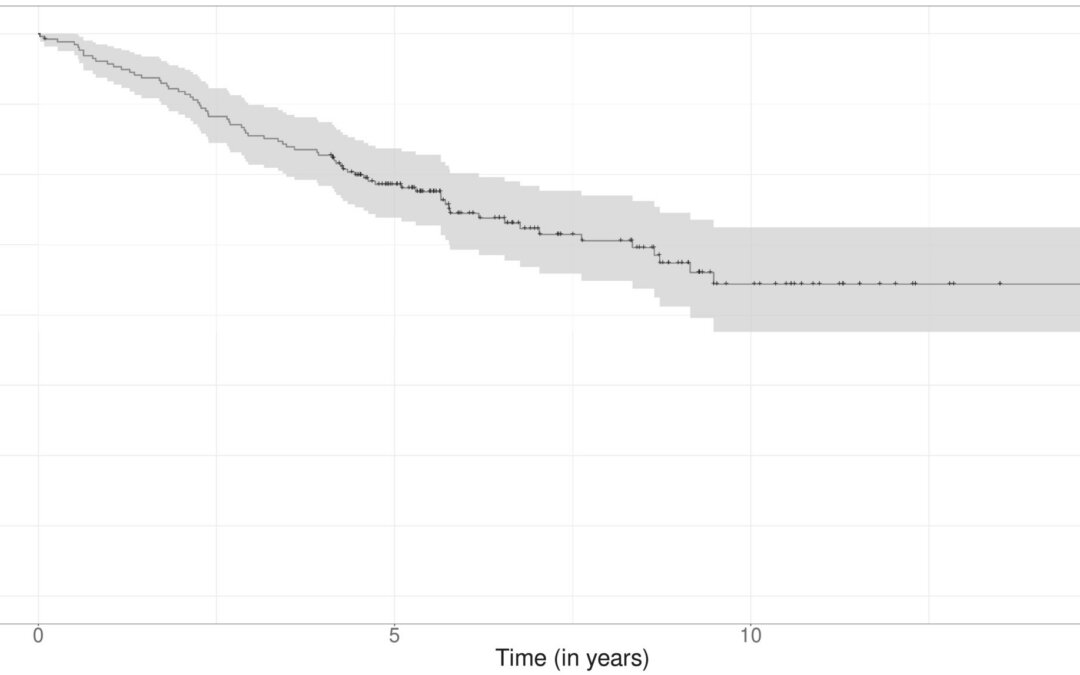
They also ran simulations to test their method. The average estimate of each model parameter come closer to the true values with the increase in sample size. They also showed that the corresponding average standard error decreases as the sample size increases. They stated that this showed empirical validation of the consistency of MLEs as estimators of the corresponding model parameters. The coverage probabilities converge to 0.95 with an increased sample size, providing empirical evidence for asymptotic normality. Simulation results concluded that their method worked well for different sets of parameters and sample sizes. They had also tested their method on a real dataset.
Written by,
Usha Govindarajulu
Keywords: time-to-event, Weibull, competing risks, mixture, cure fraction, EM algorithm
References:
Ganguly A, Sultana F, Kundu D, and Pal A (2026) “A Model Based on Mixture of Weibull Distributions for Depending Competing Risks Data in the Presence of Long-Term Survivors, and Its Application to Malignant Melanoma Cancer Data” Statistics in Medicine
https://doi.org/10.1002/sim.70466
https://onlinelibrary.wiley.com/cms/asset/2876bd5f-2430-4a1f-a48a-f4f31a41c81c/sim70466-fig-0001-m.jpg