
May 6, 2026
The win ratio introduced by Pocock et al (2012) has become a popular measure to summarize composite endpoints in clinical trials. It essentially prioritizes important events over lesser ones using an effect size as the relative frequency of wins (more favorable outcomes) to losses between treatment and comparator groups. They extended this into a proportional win-fractions regression model (PW) where the win ratio is the outcome modeled by covariates. To make treatment effects more interpretable, alternative metrics have been developed like net benefit, which is difference between win and loss proportions, and win odds, which is allocating half of the ties to each of the win and loss proportions which accounts for impact of the ties. In standard settings, a tie arises when both subjects are event-free by a certain point. As such, its probability is given by the product of two survival functions for the time to the first event (TFE), which can be predicted using any of the popular (univariate) survival models, such as the Cox proportional hazards (PH) model (Cox, 1972). They also consider the TFE along with the PW.
In this paper, they follow this approach to predict the (time-dependent) win-loss probabilities based on the PW model, thereby enabling direct comparisons between subjects with pre-specified covariate profiles and translating relative effects into clinically interpretable probability summaries over time. In the PW model, through a counting process formulation, the events are ranked from more severe to less. The outcome is determined as binary by comparing one subject’s outcome to another. They are able to setup calculating win-loss probabilities and also pairwise win residuals.They showed obtaining the estimated contrast measures: win ratio, net benefit, and win odds, given the estimated win and loss probabilities. For the win ratio, a constant feature produced solely by the PW model, is the easiest to handle for estimating and also the confidence intervals are derived from the variance matrix of beta hat. For the net benefit and win odds, plug-in estimators apply. However, the correlations between the estimated win and loss probabilities need to be accounted for in making inferences. For confidence-interval construction, it is customary to map the net benefit from its constrained range of [-1,1] onto R . This can be done, e.g., by the inverse hyperbolic tangent function.
In order to have reliable predictions for both the PW and TFE models, they must be fitting the data well and one can check this for residuals of observed minus predicted proportion of wins for the ith person (subject-specific win residual) and plot these. Also to check proportionality for the Cox model, they checked this using Schoenfeld residuals. To check this for a categorical covariate, then one can stratify the model by its levels and then create stratified PW and stratified Cox TFE models separately.
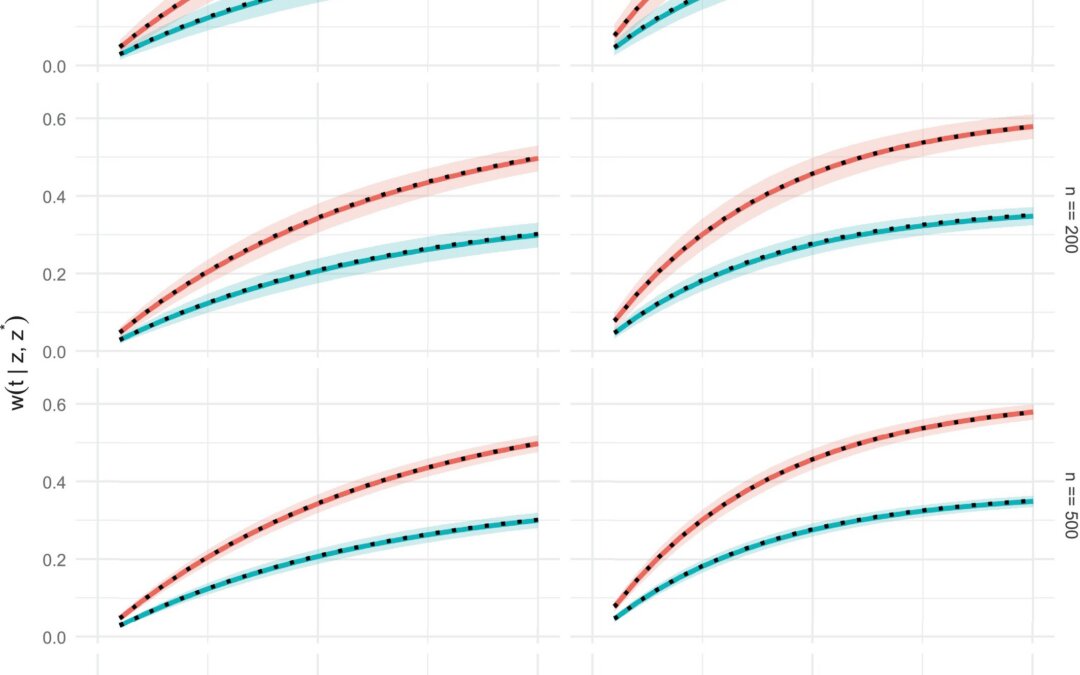
They ran simulations to evaluate the performance of the prediction procedures. Though their findings from these simulations, their studies suggest that both pointwise predictions and their uncertainty quantifications perform well in practical settings. In addition, the parsimony of the PW-TFE dual models offer the added advantage of stabilizing estimates across the time spectrum, particularly at time points where events are sparse.
They noted in their discussion that it is not guaranteed that a PW model can be seamlessly paired with any TFE model, given the overlap in the endpoints being modeled. Also, if the PW model is based solely on the TFE, their earlier work has demonstrated that it becomes equivalent to the Cox model. Their current framework is heavily dependent on the PW model and large biases can form when the temporal constraints are violated. If the main goal is prediction rather than inference than one can instead directly model the win-loss probabilities without assuming they follow a particular pattern.
Written by,
Usha Govindarajulu
Keywords: survival, win-loss, composite time-to-event outcome, proportional model
https://onlinelibrary.wiley.com/doi/10.1002/sim.70569
References:
DR. Cox, “Regression Models and Life-Tables,” Journal of the Royal Statistical Society: Series B: Methodological34, no. 2 (1972): 187–202.
Mao L (2026) “Predicting Win-Loss Probabilities for Composite Time-to-Event Outcomes Under the Proportional Win-Fractions Regression Model” Statistics in Medicine
https://doi.org/10.1002/sim.70569
S. Pocock, C. Ariti, T. Collier, and D. Wang, “The Win Ratio: A New Approach to the Analysis of Composite Endpoints in Clinical Trials Based on Clinical Priorities,” European Heart Journal33, no. 2 (2012): 112–176.
https://onlinelibrary.wiley.com/cms/asset/e0257b27-909d-4dda-8f3b-9be8d583227e/sim70569-fig-0001-m.jpg