
September 10, 2026
The authors proposed use of an outcome-adaptive Lasso (OAL) Cox proportional hazards model as a novel variable selection framework causal inference for right censored data in light of a critical limitation in survival analysis where propensity score modeling mitigates confounding bias in observational data but is highly sensitive to covariate selection. Their proposed method integrates the OAL with the Cox proportional hazards model by constructing penalty weights from coefficients estimated through the Cox partial likelihood. This design enabled OAL-Cox to effectively identify outcome-related confounders while excluding irrelevant covariates, including instrumental and spurious variables, even under censoring and correlated covariate structures. They found their OAL-Cox was more effective at reducing the inclusion of instrumental and spurious covariates than L-Cox and it also yieled more stable restricted mean survival time-based causal effect estimates in the examined settings. They focused on a causal estimand defined on the restricted mean survival time (RMST) scale rather than the hazard ratio (HR).
In their framework, they adhered to various causal assumptions: stable unit treatment value assumption (SUTVA), unconfoundedness, consistency, and positivity. They assumed conditionally independent censoring, meaning that censoring is noninformative after conditioning on treatment and baseline covariates. The PH assumption is required only for the first-stage outcome Cox model used to construct the outcome-adaptive weights. The Cox model is used as a working model to summarize the association between baseline covariates and the survival outcome, rather than to estimate the final treatment effect. The final treatment effect is estimated using the IPW-RMST estimator.
In their study, they adopted the IPW version of the RMST estimator, known as IPW-RMST, which provides a robust and causally sound estimate of treatment effects (Conner et al, 2019). This method is used to estimate the RASCE, defined as the difference between the IPW-RMST estimator for the treatment group and the IPW-RMST estimator for the control group.
As they stated, the OAL is a straightforward variant of the standard adaptive Lasso where it integrates information from the outcome model directly into its weight calculations, and this can be easily implemented with existing statistical software. Their OAL-Cox extends the OAL framework with the Cox PH model. It constructs penalty weights using coefficients derived from the Cox partial likelihood function which enables it to accurately exclude irrelevant covariates even in presence of censoring. Their resulting stabilized penalty weights impose heavier penalties on covariates that are weakly predictive of the survival outcome. Also, the tuning parameter, 𝜆𝑛, is selected by minimizing the weighted absolute mean difference (wAMD) proposed in Shortreed and Ertefaie (2017).
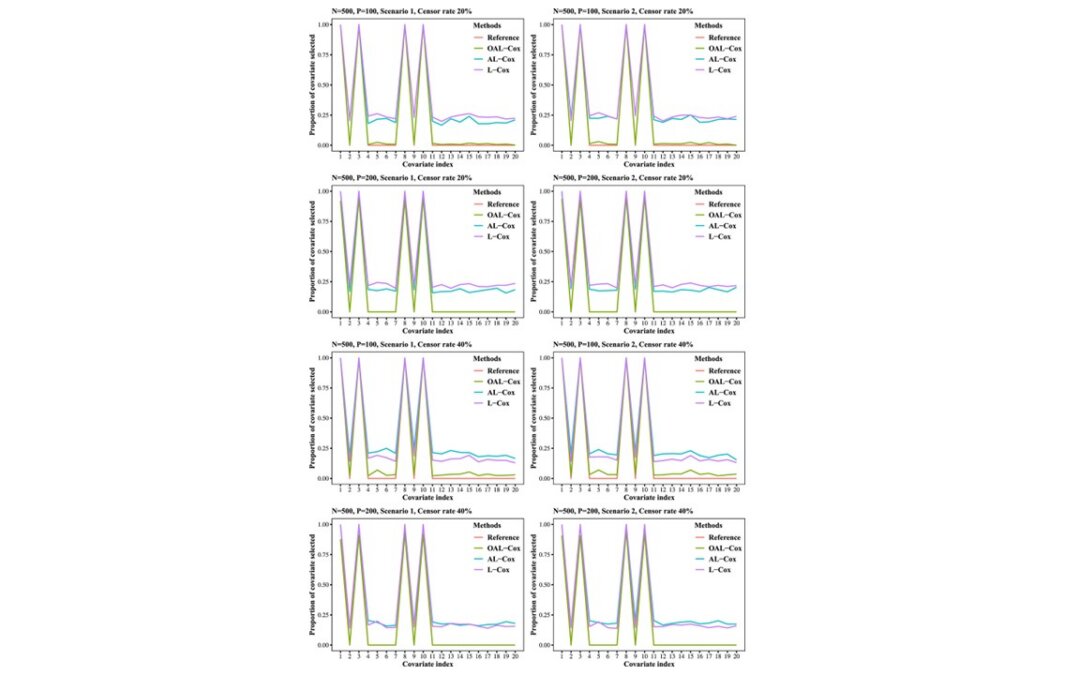
In their simulations they compared their method to several other methods including L-Cox and variations on the number of confounders and prognostic or instrumental covariates. The results showed that the OAL-Cox was more effective in excluding covariates that were unrelated to the survival outcome or were associated only with treatment assignment. Under the non-PH setting, OAL-Cox also showed satisfactory performance. Also, the RMST-based estimand remained interpretable under non-PH, and their proposed method consistently achieved smaller MSE than AL-Cox across the examined sample-size and covariate-dimension combinations. In the real data analysis, overall, OAL-Cox produced estimates comparable to those from AL-Cox and L-Cox, while maintaining its goal of excluding irrelevant covariates from the PS model.
The treatment effect is summarized by the RASCE on RMST scale, which provides an interpretable alternative to HR. They noted several limitations of the proposed model which require further study. These issues are that like other PS methods, OAL-Cox relies on standard causal assumptions, including consistency, positivity, and no unmeasured confounding. Furthermore, it can adjust only for observed baseline covariates and cannot remove bias due to unmeasured or inadequately measured confounders. One last issue is that the adaptive weights in OAL-Cox are constructed from a Cox PH model. Even the final treatment effect is estimated on the RMST scale and does not rely on an HR interpretation, the Cox model still serves as a working model for weight construction.
Their future work may extend in several directions. They may employ more flexible survival outcome models to construct adaptive weights when the Cox PH model is not adequate. In addition, extensions to multivalued or continuous treatments, time-varying treatment settings, and time-dependent covariates would broaden the applicability of OAL-Cox to more complex observational studies. Finally, another promising direction is to combine OAL-Cox variable selection with doubly robust estimation as this may further improve robustness by leveraging both PS and outcome model information.
Written by,
Usha Govindarajulu, MS PhD
Keywords: survival analysis, outcome-adaptive Lasso, Cox proportional hazards model, restricted mean survival time, causal inference
References:
Conner, S. C., L. M. Sullivan, E. J. Benjamin, M. P. LaValley, S. Galea, and L. Trinquart. 2019. “Adjusted Restricted Mean Survival Times in Observational Studies.” Statistics in Medicine 38: 3832–3860.
Liu, F., J. Liu, and H. Wang. 2026. “ Outcome-Adaptive Lasso for Cox Proportional Hazards Model.” Biometrical Journal 68, no. 5: e70168. https://doi.org/10.1002/bimj.70168
Shortreed, S. M., and A. Ertefaie. 2017. “Outcome-Adaptive Lasso: Variable Selection for Causal Inference.” Biometrics 73: 1111–1122.
Shortreed, S. M., and A. Ertefaie. 2017. “Outcome-Adaptive Lasso: Variable Selection for Causal Inference.” Biometrics 73: 1111–1122.
https://onlinelibrary.wiley.com/cms/asset/ed934a65-eabe-4580-bbaa-bd09d0cdea77/bimj70168-fig-0001-m.jpg
Lang, T., Konietschke, F., Rahnenführer, J., Kubiak, R., Brendel, M., Binder, H. and Igl, B.-W. (2026), Ensuring Quality in Preclinical Research: The Importance of Being Human. Biometrical Journal., 68: e70145. https://doi.org/10.1002/bimj.70145
https://onlinelibrary.wiley.com/doi/full/10.1002/bimj.70145?saml_referrer
U.S. Food and Drug Administration. 2025. Considerations for the Use of Artificial Intelligence to Support Regulatory Decision-Making for Drug and Biological Products: Guidance for Industry and Other Interested Parties (Draft Guidance). FDA. https://www.regulations.gov/document/FDA-2024-D-4689-0003.
Vieira, V. E., C. Henrique, S. S. Kulkarni, et al. 2025. “From Data Silos to Insights: The PRINCE Multi-Agent Knowledge Engine for Preclinical Drug Development.” Frontiers in Artificial Intelligence 8: 1636809. https://doi.org/10.3389/frai.2025.1636809.
Yang, S., X. Hu, J. Zhu, et al. 2025. “Aspects and Implementation of Pharmaceutical Quality by Design by Design From Conceptual Frameworks to Industrial Applications.” Pharmaceutics 17, no. 5: 623. https://doi.org/10.3390/pharmaceutics17050623.
Wasserstein, R. L., and N. A. Lazar. 2016. “The ASA Statement on p-Values: Context, Process, and Purpose.” The American Statistician, 70, no. 2: 129–133. https://doi.org/10.1080/00031305.2016.1154108.