
Statistical issues in survival analysis (NPH hetero covs)
September 23, 2026
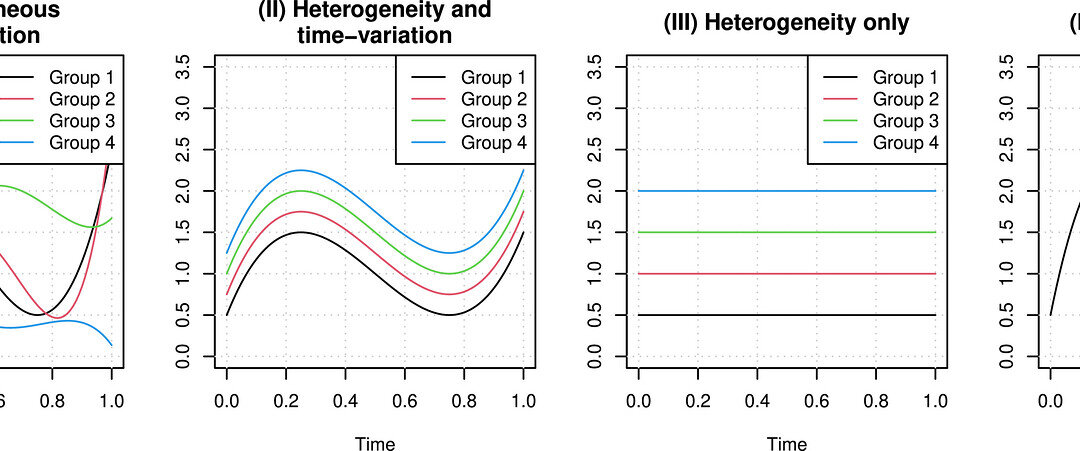
Currently there is no unified framework for incorporating heterogeneously time-varying effects of covariates. Such effects occur when a covariate affects survival not only in a heterogeneous and time-varying manner, but when the time-variation is also heterogeneous. Therefore, the authors propose to model such effects by introducing heterogeneously time-varying coefficients to piecewise exponential additive mixed models. In terms of a a new flexible hazard regression framework: Kneib and Fahrmeir (2007) introduced Cox-type structured hazard regression models. These covariate effects can be different types: linear, smooth (spline-based), time-varying effects, or random effects (frailty). Another approach they mentioned is piecewise exponential additive mixed model (PAMM; Bender et al 2018; Bender and Scheipl, 2018) which generalizes the concept of piecewise exponential models (PEM; Friedman, 1982) from linear to additive predictor terms. Its underlying idea is to divide the time axis into a finite number of intervals and assume the hazard rate to be piecewise constant within these intervals. The PAMMs avoid arbitrary choice of cut points by using a penalized regression spline rather than a step function at baseline.
The authors used PAMM as a basis for their modeling and also functional random coefficients. The piecewise exponential models (PEM) are described as an alternative to classical approaches in survival regression where the inference can be based on a Poisson model. In the PAMMs, Bender et al (2018) proposed to use a penalized regression spline as a baseline hazard to eliminate the problem of manually selecting the cut points. The standard choice of cutpoints for PAMMs are the all unique observed survival times. For estimation, ironically rather than Bayesian methods, Wood (2011) proposed a method utilizing a random effects perspective while avoiding the formal mixed model framework by using a direct Laplace approximation which integrates out the random effects (i.e. spline coefficients).
They ran simulations with different levels of heterogeneity and time-variation. Within the PAMMs to capture the these varying effects, they used functional random effects (Kneib et al, 2019) constructed as varying coefficients, which are then essentially two-dimensional anisotropic tensor product interactions between a random effect and a smooth time effect. They express the smooth time effect as the basis functions multiplied by their basis coefficients. They then rewrote the basis functions to represent the group membership and the time-varying effect, the second main effect, can be modeled using p-splines. Wood et al (2013) implemented a tenor product constructor in the R package,mgcv. In conclusion, their simulation study shows that the proposed functional random coefficient approach can flexibly capture heterogeneous time-variation within the covariate effects. In addition, if the time-variation is homogeneous, their proposed model does not lead to overfitting due to being penalized towards the true model. Only if time-variation is fully absent, slight overfitting can be observed. In a real dataset analyses, they found that the use of a functional random coefficient allowed them to capture diagnosis-specific time variation in the effect of FGA on survival. In addition, their Figure 3 shows the individual curves, which can improve the understanding of FGA as a predictor of survival.
In summary, they introduced heterogeneously time-varying covariate effects to hazard regression models, which provides an appropriate model for cases in which the effect of a covariate is not only time-varying and subgroup-specific but its time-variation is subgroup-specific, too. The proposed method makes use of the existing framework of PAMMs which enabled them to deploy a Poisson model-based inference. Their approach also allows for non-linear time-effects due to being based on penalized splines and uses a random effects basis to model the heterogeneity. In addition, the penalization mostly prevents their method from overfitting in absence of heterogeneous time-variation.
Their future possible research includes introducing this type of effect to Bayesian survival models, but it becomes a question of computational efficiency since in a Bayesian setting, for both the piecewise exponential approach and the direct approach involving an integral over the hazard rate, since they are estimating a FRE might lead to very high computational costs. Their further research is also needed to investigate whether the penalized structure of the presented approach could also be a (partial) solution to the problem that an incorrect functional form can give the appearance of non-proportional hazards reported by Abrahamowicz and MacKenzie (2007). In addition, other applications, such as use in multicenter studies, should be explored.
Written by,
Usha Govindarajulu, MS PhD
Keywords: survival analysis, PAMM, Poisson, penalized spline
References:
Abrahamowicz, M., and T. A. MacKenzie. 2007. “Joint Estimation of Time-Dependent and Non-Linear Effects of Continuous Covariates on Survival.” Statistics in Medicine 26, no. 2: 392–408.
Bender, A., A. Groll, and F. Scheipl. 2018. “A Generalized Additive Model Approach to Time-to-Event Analysis.” Statistical Modelling 18, no. 3–4: 299–321.
Bender, A., and F. Scheipl. 2018. “ pammtools: Piece-Wise Exponential Additive Mixed Modeling Tools.” arXiv:1806.01042.
Friedman, M. 1982. “Piecewise Exponential Models for Survival Data with Covariates.” The Annals of Statistics 10, no. 1: 101–113.
Hagemann, N., T. Kneib, and K. Möllenhoff. 2026. “ Capturing Heterogeneous Time-Variation in Covariate Effects in Non-Proportional Hazard Regression Models.” Biometrical Journal 68, no. 5: e70179. https://doi.org/10.1002/bimj.70179
Kneib, T., and L. Fahrmeir. 2007. “A Mixed Model Approach for Geoadditive Hazard Regression.” Scandinavian Journal of Statistics 34, no. 1: 207–228.
Wood, S. N. 2003, 01. “Thin Plate Regression Splines.” Journal of the Royal Statistical Society Series B: Statistical Methodology 65, no. 1: 95–114.
Wood, S. N. 2011. “Fast Stable Restricted Maximum Likelihood and Marginal Likelihood Estimation of Semiparametric Generalized Linear Models.” Journal of the Royal Statistical Society: Series B (Statistical Methodology) 73, no. 1: 3–36.
https://onlinelibrary.wiley.com/cms/asset/09f403af-70d0-40a2-9484-d631b0299bc0/bimj70179-fig-0001-m.jpg