
Statistical issues in survival analysis (Shared frailty # & size clusters)
October 21, 2026
The authors conducted a set of Monte Carlo simulations to assess the impact of the number and the size of clusters and within-cluster correlation in outcomes on the accuracy of the conditional predictions developed using the stratified and the shared gamma frailty Cox proportional hazards (PH) regression model. They compared the accuracy of the predictions using discrimination, calibration, and overall performance metrics. In clustered survival data, the stratified Cox PH and the frailty Cox models are the most common survival models that account for clustering (Duchateau and Janssen, 2008). They focused on conditional prediction which is defied as the prediction for a future subject belonging to an existing cluster. In stratified Cox model, clusters are handled as separate strata with cluster-specific baseline hazard functions, which are treated as fixed, stratum-specific nuisance functions estimated from the data. In the Cox frailty model, clustering is represented through a random effect (shared frailty), which captures unobserved heterogeneity. The frailty term is then predicted from the data and yields a cluster-specific estimate which can be used to generate cluster-specific (conditional) risk predictions. For mathematical and computational ease, the gamma frailty has been the most commonly used model. The Marginal frailty predictions instead average over the frailty distribution to provide risks that are not tied to a specific observed cluster and can be interpreted as predictions for a subject from a generic cluster in the population, including clusters not observed in the derived data.
In their data generating process, they varied the number of clusters, the mean number of subjects per cluster, and the within-cluster correlation in the time-to-event outcomes. They were able to vary the within-cluster correlation by using Kendall’s tau as a measure of dependence for the gamma frailty model. They used Bender et al’s (2005) approach for simulating time-to-even outcomes using a Weibull model.
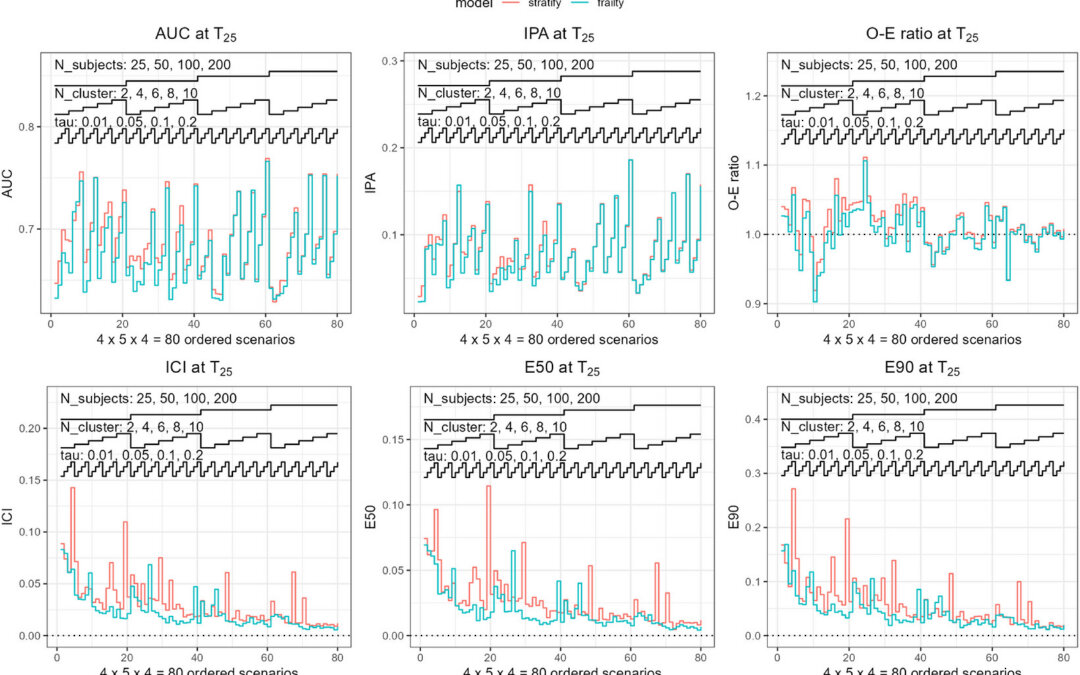
For their Monte Carlo simulations, they found that the stratified Cox model resulted in predictions at the 1st quartile with slightly higher AUC compared to the frailty model in settings with smaller cluster size and especially low homogeneity within clusters (Figure 1 top left panel) while the difference in AUC was attenuated for larger cluster size. Also, differences between the two models tended to be negligible with higher homogeneity within clusters and longer time horizons (Figures 1-3 top left panels). Furthermore, the stratum-specific (i.e., cluster-specific) baseline hazard from the stratified Cox models could not be estimated for clusters in which the time horizons were greater than the maximum event time in the derived sample so this made it impossible to estimate the corresponding predictions from the stratified Cox models and also limited the comparisons between the two models: Predictions from the stratified Cox model could not be estimated, especially in scenarios with longer time horizons, higher within-cluster homogeneity, and particularly for small cluster sizes and higher numbers of clusters Therefore, the prediction performance could not be assessed, and the corresponding prediction performance metrics could not be computed.
Both models resulted in estimates with similar IPA (IPA reflects Brier score where higher values shows better prediction) (Figures 1-3 top center panels) where the stratified Cox model resulted in slightly higher IPA at the 1st quartile, especially for small cluster size. Also, the frailty Cox model tended to result in the O–E ratio slightly closer to one compared with the stratified Cox model when clusters were simultaneously characterized by small size, low number of clusters, and low homogeneity, especially at the 1st quartile (Figures 1-3 top right panels). The use of the frailty Cox model tended to result in predictions that provided better calibration measures (ICI: ratio of sample size, median, 90th percentile) compared to the stratified Cox in several scenarios with either smaller cluster size, low homogeneity within clusters, or short time horizon (Figures 1-3 bottom panels). The difference between the two models in terms of calibration attenuated as size and number of clusters increased, especially at longer time horizons.
Per their discussion, across all scenarios, the stratified and frailty Cox had generally similar performances and they also found comparable results observed in the two applications studies. In the second application, based on bladder cancer data, the frailty model provided slightly better discrimination and calibration performances. They also claimed that “To the best of our knowledge, this is the first study to investigate the impact of number of clusters, size of clusters, and homogeneity within clusters on the prediction performance of Cox PH models for censored time-to-event clustered data using simulations. The Cox PH model is the most popular regression model for time-to-event outcomes. The Cox PH model may manage clusters nonparametrically using stratification or parametrically using the frailty (i.e., random effect) term.” They ignored our article from 2015 (Govindarajulu US and Malloy EJ. (2015). “Evaluating treatment effect in
multicenter trials with small centers using survival modeling.” International Journal of Statistics in Medical Research 4(1): 8-25. They also have claimed that frailty models are perhaps best when the number of participants and outcome events per trial are small, given the estimation issues may arise with separate baseline hazards per trial” (Riley et al.2021; Riley and Debray, 2021).
They said that their study highlights an important practical limitation of the stratified Cox model: the inability to estimate the predictions for all clusters in which the time horizons were greater than the maximum event time in the derived sample. Meanwhile, in comparison, the shared gamma frailty Cox model overcomes these limitations of the stratified Cox model, as a shared baseline hazard is estimated across clusters that enable to provide predictions over a considerably larger range of reasonable potential prediction time horizons. The authors are not novel and they have failed to obtain all appropriate citations.
Written by,
Usha Govindarajulu, MS PhD
Keywords: survival analysis, shared frailty, stratified Cox model, clustering
References:
Bender, R., T. Augustin, and M. Blettner. 2005. “Generating Survival Times to Simulate Cox Proportional Hazards Models.” Statistics in Medicine 24: 1713–1723.
Duchateau, L., and P. Janssen. 2008. The Frailty Model. Springer. https://doi.org/10.1007/978-0-387-72835-3.
Giardiello, D., E. Ratti, and P. C. Austin. 2026. “ The Impact of the Number and the Size of Clusters on Prediction Performance of the Stratified and the Conditional Shared Gamma Frailty Cox Proportional Hazards Models.” Biometrical Journal 68, no. 5: e70180. https://doi.org/10.1002/bimj.70180
Riley, R. D., J. F. Tierney, and L. A. Stewart. 2021. Individual Participant Data Meta-Analysis: A Handbook for Healthcare Research. John Wiley & Sons Ltd.
Riley, R. D., and T. P. A. Debray. 2021. “ The One-Stage Approach to IPD Meta-Analysis.” In Individual Participant Data Meta-Analysis: A Handbook for Healthcare Research. John Wiley & Sons Ltd.
https://onlinelibrary.wiley.com/cms/asset/adb53447-bb06-4d39-beb3-05a2a79a85e3/bimj70180-fig-0001-m.jpg